
Quoting
Which quote did Alex accept?
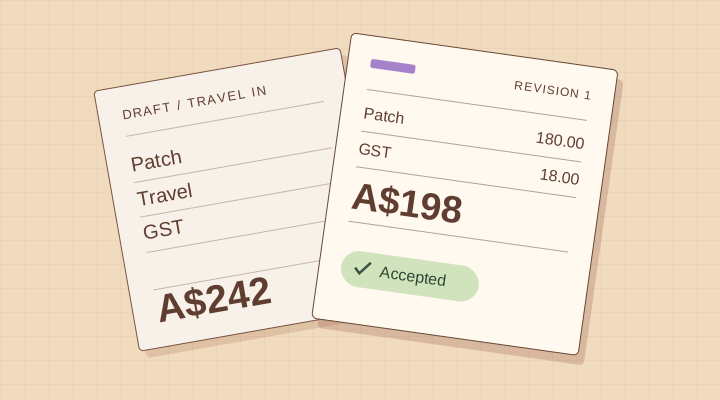
Trace a Sydney repair from A$242 with travel to A$198 without it. Record owner approval, customer acceptance and any later scope change against the right revision.
Build the draft in plain sight
The Sydney case starts with a reported 40 by 60 cm internal patch. Once the owner checks a working height of 2.4 metres, dry surface, access and the standard scope, the sample price book supplies a patch line of A$180. Adding A$40 local travel gives a subtotal of A$220. In this GST-registered sample the tax is A$22 and the displayed total is A$242. Painting is excluded.
Record the owner’s decision
For this revision the owner removes travel. A business might do this when its crew already has another job nearby. The new total is A$180 plus A$18 GST, or A$198. Keep the usual A$40 travel rate in the price book. Put the reason for the job-specific change on the revision and check the site, repair, painting exclusion and total together before approval.
Keep sending and accepting separate
Keep three events in the job history. First the owner approves a particular revision. Then the business issues that revision. Finally the customer accepts it. In the local demonstration, issuing the quote produces a local delivery record. Customer acceptance produces its own receipt against the revision and amount. When a customer asks “what did I agree to?”, open that receipt and the offer it identifies.
When something changes
Suppose the customer later asks the carpenter to replace a second door. Keep the accepted scope intact. Describe the extra door, the price difference and the effect on timing in a separate proposed change. For Alex’s plaster repair, a report of damp before acceptance instead sends the owner back to inspection. The Australian Government’s quote checklist includes itemised costs, GST where applicable, discussed revisions, expiry and space for acceptance. Business.gov.au guide to preparing quotes.